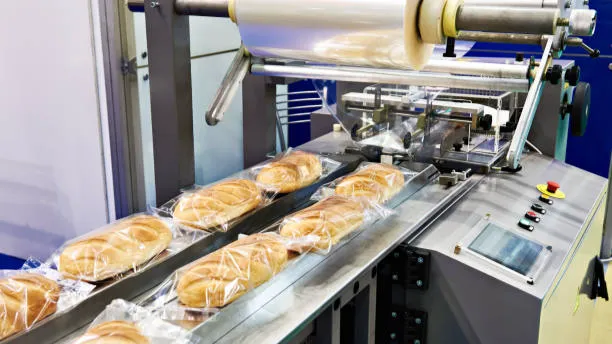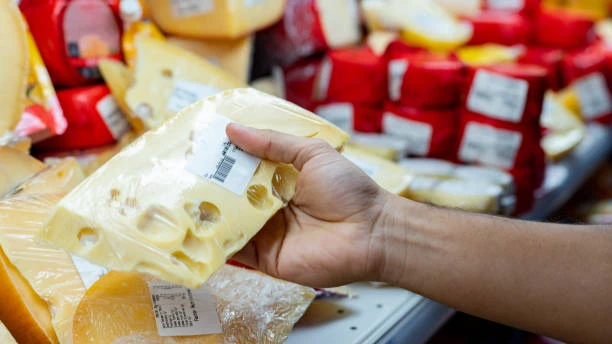
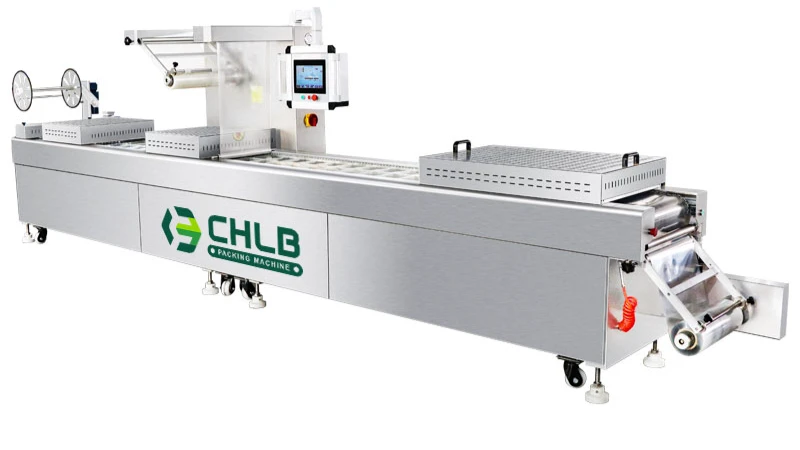
A thermoforming packaging machine forms bottom film into cavities, loads food products, seals a top film, and cuts individual packs. Integrated into a food packaging line, it reduces the need to store premade trays, while packaging performance depends on film structure, outillage, and machine settings.
This guide covers thermoforming processes, compares rollstock thermoforming with premade tray sealing, and explains packaging modes, film selection, production output, and tooling considerations for meat, fromage, fruit de mer, plats cuisinés, et aliments surgelés.
How a Thermoforming Packaging Machine Works
A thermoforming packaging machine forms plastic film into cavities, charge des produits, seals the packs, and cuts them into individual units. The process typically involves five steps.
1. Film Feeding and Heating
The machine advances the forming film to the heating station, where contact plates or radiant heaters soften it to the required forming temperature.
2. Film Forming
Vacuum draws the softened film against a mould. Compressed air or a plug assist may be used to form deeper cavities and improve material distribution. The mould determines the cavity dimensions and depth.
3. Product Loading
The formed film moves to the loading station, where operators or automated systems place products into the cavities.
4. Sealing and Gas Flushing
The machine positions the top web over the loaded cavities. Depending on the packaging requirements, it may evacuate the cavities, flush them with a gas mixture, or combine both processes before sealing the two webs together.
5. Cutting and Pack Separation
The sealed web moves to the cutting station, where individual packs are separated and excess film is removed.
Rollstock Thermoforming vs. Premade Trays for Food Packaging Lines
Both formats seal a film lid onto a container, but they differ in how the container is supplied. Rollstock thermoforming forms trays directly from bottom film on the packaging line, while tray sealing uses pre-formed trays. For food packaging lines, this decision affects material costs, storage space, temps de changement, et flexibilité de production.
| Decision factor | Rollstock thermoforming | Premade tray sealing |
|---|---|---|
| Container supply | Formed in-line from bottom web film | Bought pre-formed and stored as trays |
| Pack shape | Set by mould, so custom depths and profiles are possible | Limited to the tray sizes and depths you can source |
| Passage | Tooling swap plus film change, typically the slower route | Change tray and film, usually faster across many SKUs |
| Logistics | Rolls take less space than an equal number of trays | Trays add freight, storage and hygiene handling |
| Best fit | Few formats, high volume, tight pack specifications | Wide SKU range, seasonal or promotional tray designs |
Buyers running a narrow format range at volume usually recover the extra tooling cost through film economics, because the bottom web is priced per kilogram rather than per tray. Buyers switching formats weekly usually do better with trays.
Size a Thermoforming Line Around Your Pack
Vide, MAP and Skin Packaging Modes for Food Packaging Lines
Food packaging lines can use vacuum, modified atmosphere packaging (CARTE), or vacuum skin packaging to meet different requirements for shelf life, product appearance, and pack format. The right mode depends on the food product, conditions de stockage, and retail presentation requirements.
Vacuum Thermoforming
The machine forms cavities, charge le produit, removes air, and seals the pack. Vacuum packaging limits oxygen exposure, helping reduce aerobic spoilage and fat oxidation.
It is commonly used for fresh meat primals, fromage, and other products that benefit from reduced oxygen exposure. Cependant, vacuum can darken fresh red meat by changing myoglobin colour, which may affect its suitability for retail display.
Thermoformage MAP
Modified atmosphere packaging replaces the air inside the pack with a controlled gas mixture before sealing. Gas composition varies by product: high-oxygen mixtures may help maintain the bright red colour of fresh meat, while carbon dioxide helps inhibit microbial growth and nitrogen can reduce pack collapse.
MAP can extend shelf life under suitable conditions, but the results depend on the food, gas ratio, residual oxygen, film barrier properties, and cold-chain management. Gas mixtures should be validated for the specific product rather than applied as universal settings. Read more about the MAP process.
Emballage sous vide
Vacuum skin packaging uses a heated top film that conforms closely to the product, leaving minimal headspace. The film seals to the bottom web or a suitable support board.
This format suits retail steaks, bacon, viande tranchée, and seafood fillets where product visibility, présentation, and purge control are important. Film selection must account for product height, forme, and puncture risks, particularly when packaging products with sharp bones or shells.
For food packaging lines, the final choice should balance shelf-life requirements, retail presentation, film performance, and compatibility with the intended product and production process.

Film Structures for Food Packaging Lines
Film selection affects forming performance, intégrité du joint, and product protection on a food packaging line. Thermoforming machines use two film webs: the bottom web forms the cavities and provides structural strength and barrier protection, while the top web seals the packs and affects appearance and barrier performance.
Common bottom-web structures include PA/PE for toughness and formability, with EVOH added when higher oxygen barrier performance is required. Film thickness and structure depend on cavity depth, exigences du produit, and mould design. The top and bottom webs must also have compatible sealing properties.
Three factors determine material suitability:
- Draw ratio: Deeper cavities increase material stretching and the risk of corner thinning.
- Compatibilité des joints: Both webs need a suitable overlapping sealing temperature range for reliable seals.
- Compliance requirements: Food-contact regulations, migration limits, and recyclability targets may restrict material choices.
Test the intended film combination on the actual mould before finalizing specifications.
Output, Tooling and Changeover for Food Packaging Lines
For a food packaging line, actual output depends on cycle speed, cavity count, format du paquet, et les conditions de production. A four-cavity mould running at eight cycles per minute produces 32 packs per minute before accounting for downtime and rejected packs.
When requesting a quotation, confirm four key figures:
- Actual output: Packs per minute at your specified pack size and cavity layout.
- Film utilization: Material consumption per pack, including trim waste.
- Changeover time: Time required to switch formats and produce the first acceptable pack.
- Quality standards: Seal-strength requirements, leak-testing methods, and acceptance criteria.
Tooling costs also affect the total investment. A typical setup may require a forming mould, sealing tooling, and a cutting die for each pack format. Ask the supplier to itemize these costs and clarify which components can be reused across different formats. This makes it easier to compare equipment costs and future changeover expenses.
Matching Packaging Formats to Products on a Food Packaging Line
| Produit | Format and atmosphere | What to check first |
|---|---|---|
| Fresh red meat cuts, retail | Thermoform MAP or skin, high-oxygen mix | Colour retention over display life, not just day one |
| Primal cuts, wholesale | Thermoform or bag vacuum, no gas | Drip control and bag puncture from bone |
| Sliced bacon, ham, deli | Skin pack or low-oxygen MAP | Oxidation and greying under retail lighting |
| Hard and semi-hard cheese | Thermoform vacuum or low-oxygen MAP | Barrier level needed for the ripening stage |
| Frozen portions and patties | Thermoform vacuum, high cycle rate | Film toughness at deep-freeze temperature, not at packing room temperature |
Pensées finales
A reliable food packaging line depends on the right combination of film structure, pack design, and machine capacity. These factors affect packaging quality, production output, et les frais de fonctionnement.
Before requesting quotes, prepare your product dimensions, sortie cible, exigences en matière de durée de conservation, and gas-flushing specifications if applicable. Ask suppliers to confirm production speed, film utilization, and tooling costs for your intended pack format.
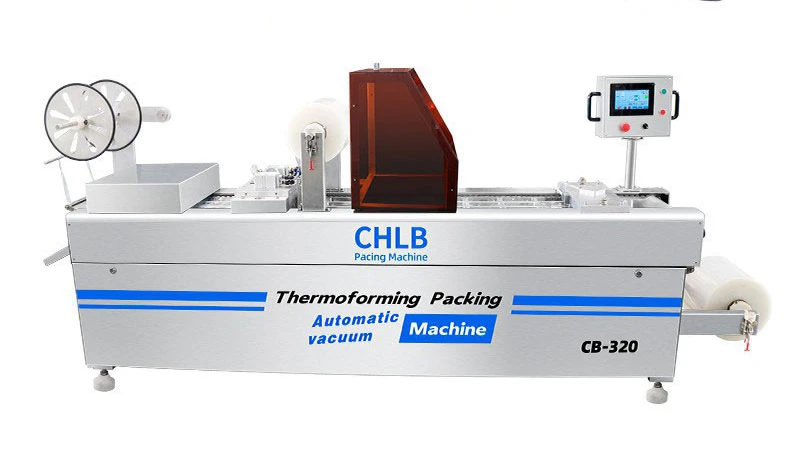
Explore our thermoforming machine manufacturers guide to compare suppliers. CHLB provides continuous thermoforming vacuum packaging machines for industrial food packaging applications.
Foire aux questions
Is a thermoforming packaging machine the same as a vacuum former?
Non. Industrial vacuum forming shapes sheet plastic into trays, cups or panels and is a packaging production step. A thermoforming packaging machine forms a cavity, le remplit, seals a top web and cuts the pack in one pass, so it packs product rather than making empty containers.
Can one thermoformer run vacuum, MAP and skin packs?
Often yes, if the machine is ordered with the right stations and the tooling suits each format. Gas flushing needs a modified atmosphere package configuration, and skin packs need a suitable top web and a support surface. Confirm machine settings and tooling per format before you buy.
How deep can a thermoforming machine form a cavity?
Machine literature frequently lists forming depths of 60 à 150 mm on food machines, but depth alone is not the limit. The draw ratio and the resulting corner thickness decide whether the pack holds up. Test the deepest, sharpest product you intend to run.
What usually causes leakers and seal failures?
Product or grease trapped in the seal area, a mismatched top and bottom web, sealing temperature drift, and worn sealing dies cause most leaks. Ask the supplier which inspection step catches each one, and whether leak testing runs per shift or per batch. The method matters as much as the equipment.