Every week of shelf life lost to the wrong packaging method is money written off as spoilage, 返品, and waste. This guide compares vacuum packaging vs other food packaging methods — MAP, tray sealing and overwrap, shrink, and skin packaging — so you can see exactly where each one wins on shelf life, 色, and cost before you commit.
By the end, you will have a method-by-method decision rule your production and sales teams can apply the same day — and a shortlist of equipment to run it.
Vacuum Packaging vs Modified Atmosphere Packaging (地図): 主な違い
These are the two preservation-focused methods food producers compare most often. Both extend shelf life; they do it in opposite ways.
How the Two Methods Work
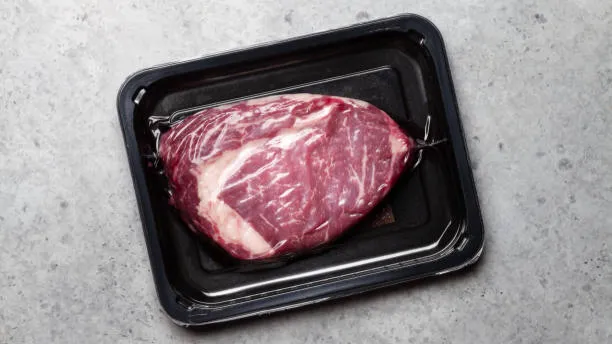
Vacuum packaging removes nearly all air from a high-barrier bag or pack and seals it hermetically. In the oxygen-poor environment that follows, aerobic spoilage bacteria and oxidation slow dramatically — the same mechanism that makes vacuum the standard for primal cuts, processed meat, and long chilled storage. The trade-off: without oxygen, fresh red meat loses its bright red bloom and looks darker in the pack.
Modified atmosphere packaging (地図) does not remove air; it replaces it. The pack is flushed with a controlled gas mix — typically carbon dioxide (CO₂) to inhibit spoilage microorganisms, nitrogen (N₂) as an inert filler, そして, for red meat, a high share of oxygen (O₂) to keep the product looking bright red — then sealed in a high-barrier film so the mix stays stable.
| 側面 | 地図 | 真空包装 |
|---|---|---|
| Package atmosphere | Replaced with a controlled gas mix | Air removed, leaving very little residual gas |
| Main goal | Balance shelf life with retail appearance | Remove air to reduce oxygen exposure |
| Meat color | Bright red with high-oxygen mixes | Darker while sealed |
| 貯蔵寿命 | Often longer than overwrap; results depend on the gas mix and product | Can extend chilled shelf life, depending on the product and storage conditions |
| Typical use | Retail-ready fresh meat, 家禽, and case-ready lines | Primal cuts, processed meat, bulk distribution, and some frozen products |
Where Each Method Wins
Vacuum packaging wins when the priority is shelf life, yield, and logistics: bulk distribution, frozen storage, export, processed and cured meats, and any pack that must stay sealed for weeks. MAP wins when the product is sold on appearance: supermarket case-ready red meat, 家禽, and ground meat in retail trays, where color is what sells.
As a rule of thumb: sell fresh and fast, use overwrap or MAP; store long and ship far, use vacuum. If display color is non-negotiable, shelf life is part of what you trade for it.
Vacuum Packaging vs Tray Sealing and Overwrap
For fresh retail meat, these two formats are what vacuum packaging is most often measured against.
Vacuum Packaging vs Overwrap Trays
Overwrap places the meat on a foam or plastic tray and stretches a PVC or PE film over it. It is cheap, fast, and shows the product fully — but it is aerobic by design: the permeable film lets oxygen through so the meat stays bright red, and shelf life stays short at 3–7 days. That makes it right for high-turnover retail and butcher counters.
The same cuts in a vacuum pack look darker, but they keep 14–20 days chilled and much longer frozen. For wholesale, フードサービス, and anything that will sit before sale, vacuum is the safer choice.
Vacuum Packaging vs Tray Sealing
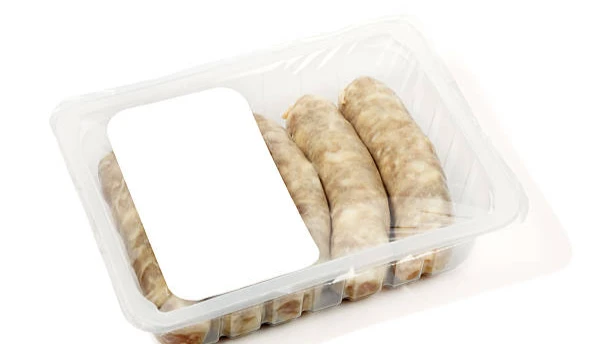
トレイのシーリング is often mistaken for a rival to vacuum, but it is really a machine format. A sealed tray can carry a simple overwrap-style film, a MAP atmosphere, or — in vacuum skin packaging and vacuum tray sealing — a vacuum. Comparing tray sealing to vacuum packaging is really comparing what is inside the tray.
When a tray sealing line runs MAP, the trade-off is the MAP-vacuum comparison above. When it runs vacuum, you get vacuum’s shelf life in a rigid, retail-friendly pack — which is why vacuum skin packs dominate the premium chilled segment.
| 側面 | Overwrap Tray | トレイのシーリング (地図) | 真空包装 |
|---|---|---|---|
| Package atmosphere | Aerobic — oxygen reaches the meat | Replaced with a controlled gas mix | Air removed, leaving very little residual gas |
| Meat color | Bright red | Bright red with high-oxygen mixes | Darker while sealed |
| Chilled shelf life | 3–7 days | Longer than overwrap; depends on the gas mix | 14–20 days for fresh cuts |
| Cost per pack | Lowest | より高い | より高い |
| Best for | High-turnover retail and butcher counters | Case-ready fresh meat and poultry | Wholesale, フードサービス, and longer storage |
Find the Right Food Packaging Solution for Your Products
Vacuum Packaging vs Shrink Packaging
Shrink packaging solves a different problem: fit. A bag or film is heated so it contracts tightly around the product, locking irregular cuts, whole poultry, and large primals in place, preventing movement damage and producing a tidy pack.
On its own, plain shrink wrap does not remove oxygen, so it adds little shelf life. The formats that deliver both are shrink vacuum bags — evacuated first, then shrunk — which are the standard for primal cuts and meat logs in B2B transport and maturation.
Choose plain shrink wrap when the goal is presentation and handling efficiency; choose a shrink vacuum bag when you also need vacuum’s preservation.
| 側面 | Shrink Packaging | 真空包装 |
|---|---|---|
| Core job | Tight, conforming fit around the product | Oxygen removal and hermetic sealing |
| Shelf-life effect | Minimal on its own | Extends chilled shelf life, depending on the product and storage conditions |
| Product fit | Irregular cuts, whole poultry, large primals | Cuts, processed meat, bulk, and frozen products |
| Typical use | Presentation, 取り扱い, and transport of large cuts | Long storage, wholesale, そして配布 |
Vacuum Skin Packaging vs Standard Skin and Blister Packaging
VSP vs Standard Skin Packaging
Standard skin packaging drapes a film over the product and seals it to the tray, giving a tight, leak-resistant, tamper-evident pack. It protects and displays well, but it does not evacuate the atmosphere.
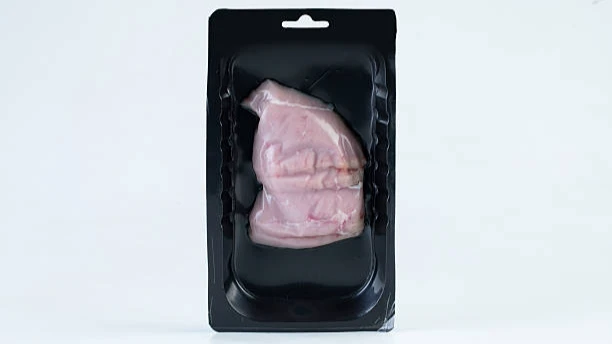
真空スキンパッケージ (VSP) takes the same format and removes air as the film conforms, producing the familiar “second skin” pack with minimal headspace. VSP keeps the display appeal and adds real preservation: less purge, less oxidation, and longer shelf life. That is why premium steaks and export chilled cuts use it.
VSP vs Blister Packaging
Blister packaging — a rigid preformed cavity sealed with film or foil — belongs mainly to non-food retail such as electronics, tools, and pharmaceuticals, where visibility and tamper evidence matter more than atmosphere control.
For food, VSP plays the same visual role with an oxygen barrier a blister does not need. Keep the non-food format out of fresh food lines and choose VSP instead.
| 側面 | Standard Skin Packaging | Blister Packaging | VSP |
|---|---|---|---|
| Atmosphere | Air remains in the pack | Air remains; not a barrier format | Air evacuated as the film conforms |
| Main purpose | Display and leak resistance | Visibility and tamper evidence | Premium display plus preservation |
| Typical use | Retail food packs | Electronics, tools, 医薬品 | Premium steaks and export chilled cuts |
| Shelf-life effect | Limited | Not designed for fresh food | Extended — less purge, less oxidation |
How to Choose the Right Packaging Method
The comparison above reduces to three questions: what product are you packing, what is the priority, and how good is your cold chain.
Match the Method to Your Product
| 製品 | Best for Retail Display | Best for Storage and Transport |
|---|---|---|
| Fresh red meat cuts | High-oxygen MAP, overwrap | 真空 |
| Premium cuts and steaks | VSP | VSP or vacuum |
| Ground meat | 地図 | 真空 |
| Processed and cured meat | Vacuum or MAP | 真空 |
| Whole poultry, large primals | Shrink wrap | Shrink bags or vacuum |
| Frozen meat and export | — | 真空, shrink bags |
すぐに食べられる, shelf-stable products sit outside this decision: retort pouches and cans handle sterilization and ambient storage, which none of the chilled formats above can do.
Match the Method to Your Priority
- Longest shelf life and lowest waste: vacuum — or VSP when display quality also matters.
- Bright color and fast retail turnover: overwrap or high-oxygen MAP.
- Premium presentation with preservation: VSP.
- Handling efficiency for irregular cuts: shrink, or shrink vacuum when shelf life matters too.
Factors That Matter as Much as the Package
- Cold chain: vacuum and MAP only deliver their shelf-life numbers under refrigeration; a warm chain erases the difference between methods.
- Film barrier: the pack must actually hold the vacuum or gas mix. Vacuum films need oxygen permeability below roughly 2 mL/m²/24 h/bar, while retail bloom films deliberately run far higher. High-barrier multilayer structures (PA/PE, EVOH, PVDC) are what make the preservation methods work.
- Hygiene and seal integrity: a method is only as good as the initial microbial load of the product and the reliability of the seal.
- Verify on your own line: run trial packs under your real storage and distribution conditions before committing to a format.
Equipment You Need for Each Packaging Method
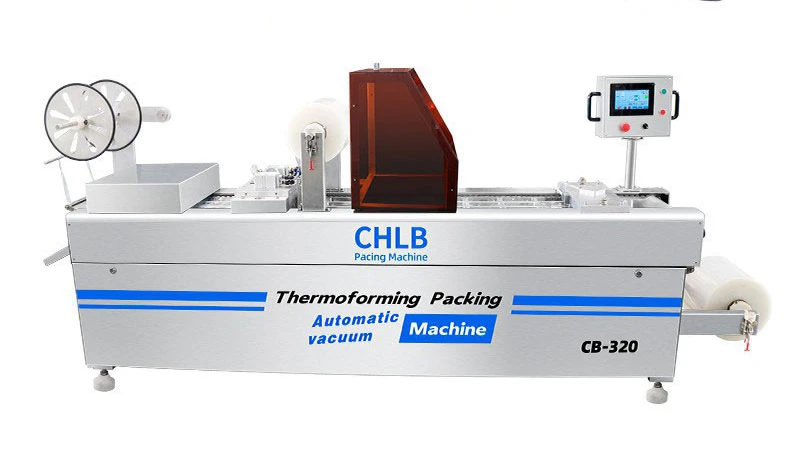
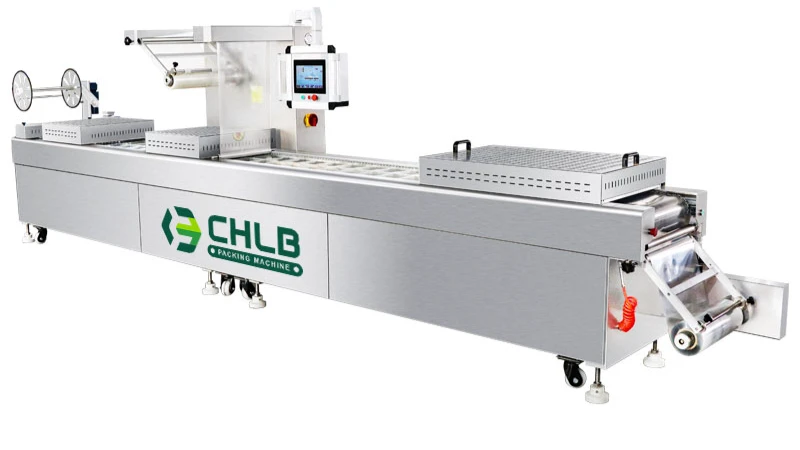
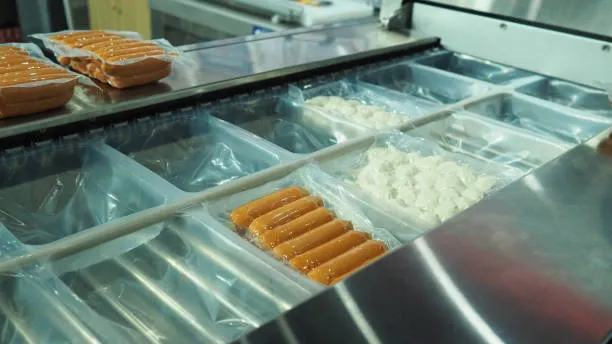
- 真空包装: chamber vacuum machines for small and medium volumes, thermoforming vacuum lines for high-volume fresh meat, plus shrink tanks or tunnels where shrink bags are used.
- 地図: tray sealers with gas flushing or thermoformers with MAP stations, together with a gas mixer.
- Overwrap: stretch overwrapping machines — low investment and high line speed.
- Shrink packaging: shrink tunnels or hot-water tanks.
- VSP: dedicated skin packaging machines.
Line speeds differ by format: an overwrap line of a given class runs faster than a vacuum thermoforming line, but the vacuum line buys shelf life instead of speed. When volumes grow, integrated lines add weighing, 検査, ラベリング, and case packing so the packaging method does not become the plant’s bottleneck.
最終的な考え
Vacuum packaging keeps its shelf-life edge for storage, bulk, and long-distance distribution; MAP wins the retail display battle; overwrap keeps costs down for fast turnover; and VSP delivers premium presentation without giving up preservation. No single method beats the others everywhere — the comparisons above show which one fits your product, your channel, and your cold chain.
CHLB engineers complete vacuum, 地図, and tray-sealing lines for food producers at every scale. Tell us your product and target shelf life, and our team will recommend the method and machine combination that fits your factory.
よくある質問
Is vacuum packaging better than other food packaging methods?
Better depends on the objective. For shelf life, 廃棄物の削減, and distribution logistics, vacuum packaging is a strong option for many chilled meat and processed products. For retail display color and fast turnover, MAP or overwrap may be more suitable. Match the packaging method to the product and its priorities.
Which packaging keeps food fresh the longest?
Vacuum packaging and vacuum skin packaging (VSP) with high-barrier films can extend the refrigerated shelf life of many meat products, while properly designed MAP also provides effective preservation. Under suitable chilled conditions, vacuum-packed beef primals may last 35–45 days or longer, depending on temperature, initial product quality, と取り扱い, compared with approximately 3–7 days for overwrapped meat. Actual shelf life must be validated for each product and process.
Does vacuum packaging change meat color?
はい. When oxygen is removed, fresh red meat often appears darker or purplish while sealed. After opening, the meat can regain a brighter red color as its surface is exposed to oxygen. This color change is one reason vacuum packaging is less common for conventional fresh red meat display packs.
What materials are used for vacuum and MAP packaging?
Vacuum and MAP packaging commonly use multilayer barrier films containing materials such as PA (nylon), PE, EVOH, or PVDC to limit oxygen transmission. Overwrap typically uses permeable PVC or PE stretch film, while trays may be made from foam, PP, or PET. The appropriate material depends on the product, シール要件, バリア性能, および保管条件.
Can one machine run both vacuum and MAP?
はい, some thermoformers and tray sealers support both vacuum sealing and gas-flush MAP, depending on the machine configuration. Before purchasing, confirm that the equipment supports both processes, the required packaging formats, and the gas-control and sealing specifications for your products.
Is vacuum packaging suitable for fresh retail display?
Vacuum packaging is not usually the first choice for conventional fresh red meat display because oxygen removal makes the meat appear darker while sealed. Overwrap and high-oxygen MAP help maintain a bright red appearance. For retailers seeking both product visibility and close-fitting protection, 真空スキン包装 (VSP) can be a suitable alternative.