>

식품 포장 기계: 유형, Uses & Buying Guide

식품 포장 기계: 유형, 용도 & 구매 가이드

공유하다:

목차

Choosing the right food packaging machine today is about much more than production speed. Manufacturers must balance food safety, automation efficiency, and growing sustainability requirements—while staying compliant with stricter industry standards.

This guide explains food packaging machines in clear, practical terms—from common systems like VFFS and horizontal flow wrappers to automation levels, product compatibility, and key food safety standards such as FDA and ISO 22000. We also break down real ownership costs and future-ready packaging trends.

~에 CHLB 그룹, we help food producers choose and integrate packaging solutions that fit their products, production goals, and long-term growth. Visit us to speak with our packaging specialists and explore tailored food packaging systems.

Navigating the 2026 Food Packaging Landscape

영상

그만큼 2025 food packaging landscape is characterized by stringent hygienic design standards (SS304/SS316, IP67-IP69K), advanced high-speed automation integrating AI and IoT, and a strong push towards sustainability-ready materials and traceable labeling to meet evolving consumer and regulatory demands.

위생적인 디자인 & Regulatory Compliance

Materials & Construction: Primary food-contact and washdown areas utilize AISI 304 그리고 316 스테인레스 스틸 (SS304/SS316) with sloped surfaces and minimal crevices for sanitary design.

Ingress Protection: Robotics and enclosures aim for IP67–IP69K ratings to endure high-pressure, high-temperature washdown and caustic Clean-in-Place (CIP) 약.

Regulatory Alignment: Machines are engineered to comply with FDA, USDA sanitary expectations, HACCP, ISO-based food safety schemes, and the Food Safety Modernization Act (FSMA).

High-Speed Automation & Sustainable Innovations

처리량 & Line Capacity: VFFS systems like the Bosch SVE 2520 DZ achieve up to 300 분당 가방; automated lines process thousands of units per hour with servo-driven controls.

Automation Stack: Integration of servo motors, pneumatic actuators, vision systems, PLC/HMI controls, IoT sensors, and AI-based inspection for defect detection and traceability.

Sustainability Compatibility: New systems handle recyclable films, paper-based trays, compostable, and biodegradable films, requiring optimized sealing temperatures and pressures.

Industry Investment: PMMI’s ‘State of the Industry 2025report highlights capital shifts towards sustainability-ready machinery, higher automation, and IoT-enabled lines.

Classification: Vertical vs. Horizontal vs. Rotary

Food packaging machines are fundamentally classified by their mechanical architecture: Vertical (VFFS) uses gravity for compact, downward film and product flow; Horizontal (HFFS) moves products and film horizontally for high-speed, stable wrapping; and Rotary employs a circular turret for multi-station processing of premade pouches or rigid containers, optimizing space. Each excels in different applications based on product type, 속도, and footprint.

Machine Type Operational Principles & Performance Suitable Products & Footprint
Vertical Form-Fill-Seal (VFFS) Uses gravity for downward film and product flow. Film unwinds, forms a tube, product drops, then sequential vertical sealing/cutting. 처리량: 150–300 bags/min. Ideal for products that flow (분말, 과립, 액체, 냉동 품목, 간식, 커피, sugar, rice). 콤팩트, low-footprint, tall-and-narrow design; requires less floor space than horizontal for equivalent capacity.
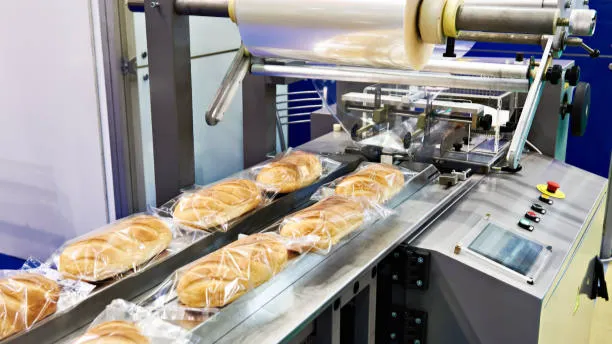
Horizontal Flow-Wrap (HFFS) Product and film move horizontally. Product pushed/conveyed into film tube, sealed longitudinally and at ends. Product is supported for stable high-speed handling. 처리량: >400 bags/min for standardized items. Optimal for single, solid items (예를 들어, cereal bars, 베이커리 제품) where geometry preservation is critical. Generally requires more linear space compared to VFFS for equivalent capacity.
Rotary Architecture Utilizes a circular turret indexing products/pouches through 6–12 radial stations for open, fill, seal, 등. Premade-pouch throughput: ≤60 bags/min. Rotary indexing for cups/trays provides high-speed, high-volume production. Washdown-ready design for rigid containers. Suitable for premade pouches (versatile formats, flexible fill volumes) and rigid containers (cups, bowls, 쟁반, medical-nutrition containers). High function density in smaller square/circular footprints; optimizes space.

Core Architectural Principles & Product Flow

Vertical Form-Fill-Seal (VFFS): Film unwinds downward, wraps a forming tube, product drops by gravity, followed by sequential vertical sealing and cutting. Favors products that flow (분말, 과립, 액체, frozen particulates).

Horizontal Flow-Wrap (HFFS): Product and film move along a horizontal axis; product is pushed or conveyed into a film tube, sealed longitudinally on the underside, and then end-sealed by rotating or reciprocating jaws. Ideal for single, solid items.

Rotary Architecture: Utilizes a circular turret or turntable that indexes products or premade pouches through multiple radial stations (typically 6–12) for operations like opening, 충전재, 밀봉, and optional checks. Concentrates many operations into a compact footprint.

Operational Throughput, 애플리케이션, and Space Efficiency

Vertical (VFFS): Throughput of 150–300 bags/min; suitable for diverse products like snacks, 커피, sugar, and frozen items. Offers a compact, low-footprint, tall-and-narrow design, requiring less floor space than horizontal for equivalent capacity.

Horizontal (HFFS): Achieves >400 bags/min for standardized items (예를 들어, cereal bars, 베이커리 제품); optimal for high-volume runs of solid, uniform products where geometry preservation is critical. Products are supported, allowing stable high-speed handling.

Rotary (Premade Pouch/Rigid Containers): Premade-pouch versions typically reach ≤60 bags/min; rotary indexing for cups/bowls/trays provides high-speed, high-volume production. Offers high function density in smaller square/circular footprints. Rotary premade-pouch machines allow more flexible filling volumes, though high fill weights may require speed reductions due to centrifugal forces, where horizontal premade-pouch lines can be more stable.

지능형 포장 기계: Precision, Performance, Profit.

As a leader in intelligent packaging, CHLB Group engineers precision solutions that elevate your production efficiency and minimize operational costs. Partner with us for custom-built, hygienic machinery that ensures superior performance and long-term reliability for your global operations.

우리의 솔루션 살펴보기 →

CTA 이미지

Matching Machine Type to Product Consistency (Solid vs. 액체)

Machine selection for packaging hinges primarily on product rheology—its viscosity, presence of particulates, and flow behavior. Free-flowing solids typically use gravity-fed VFFS systems with multihead weighers, while liquids and semi-solids require positive-displacement pumps and specialized hygienic materials like SUS316 stainless steel.

Product Consistency Typical Machine & Dosing System Key Features & Materials
Free-flowing Solids (Granulates, Powders, Piecewise) VFFS/HFFS or can/bottle lines with Multihead Weighers, 오거 필러, or Volumetric Cup Fillers. Gravity-fed, high-speed continuous motion (최대 300 bags/min/tube), suitable for snacks, confectionery, 냉동식품.
Viscous Liquids & Semi-solids (Pastes, Gels, Particle-containing) Multilane Sachet/Stick-pack/Pouch machines with Servo Piston, Gear, or Rotary Pumps. Positive-displacement metering, intermittent motion (40-80 cycles/min), SUS316 product-contact parts, GMP/CE/CUL compliant.

Differentiating Packaging Systems by Product Rheology and Form

The primary engineering discriminator for machine type is product rheology (viscosity, presence/size of particulates) and its form (free-flowing solid, powder, liquid, or paste).

Free-flowing solids like snacks, 사탕, 견과류, and powders are typically handled by VFFS or horizontal systems, utilizing gravity-fed or auger dosing mechanisms.

Viscous liquids and semi-solids (예를 들어, 소스, gels, creams) necessitate positive-displacement metering and a hygienic, corrosion-resistant product path.

Specialized Machine Configurations for Liquid, Semi-Solid, and Dry Product Handling

Liquid and semi-liquid machines (예를 들어, multilane sachet systems) use servo piston, servo gear, or servo rotary pumps to handle viscosities from 5–50,000 cP, including particle-containing pastes.

Product-contact parts for liquids often require SUS316 stainless steel to meet GMP and CE requirements for hygienic and corrosion-resistant operation.

Solid product handling (granulates, 분말, piecewise solids) employs VFFS systems with multihead weighers, auger fillers for powders, or volumetric cup fillers for granulates.

Output capabilities vary: high-speed VFFS for free-flowing solids can reach up to 300 튜브 당 가방/분, while liquid/paste multilane sachet machines typically achieve 40–80 cycles/min.

Choose the Right Packaging Machine for Your Food Business

영상

Once you understand the different types of food packaging machines available, the next step is selecting the one that best fits your production needs. Choosing the right machine is not just about capacity—it’s about aligning performance, 유연성, and long-term value with your business goals. Below are the key factors to consider when selecting an automatic food packaging machine.

1. Match the Machine to Your Product Type

Start by evaluating what you are packaging. Liquids, 분말, 냉동식품, and solid snacks all require different filling and sealing technologies. Consider your product’s size, weight, 조직, and sensitivity to ensure the machine can handle it accurately without causing spills, breakage, or waste.

2. Define Your Production Volume and Speed Requirements

Packaging speed directly affects productivity and delivery timelines. High-volume operations may need machines capable of continuous, high-speed output, while smaller or growing businesses may benefit from flexible machines that allow easy scaling. Choose a speed range that supports both current demand and future growth.

3. Balance Budget with Long-Term ROI

While advanced food packaging machines offer automation and efficiency, it’s important to look beyond the upfront price. Consider total cost of ownership, including maintenance, energy consumption, downtime, and waste reduction. A slightly higher initial investment can often deliver better returns over time.

4. Evaluate Customization and Flexibility

Modern food businesses often manage multiple SKUs and packaging formats. Machines that support adjustable bag sizes, different materials, or quick changeovers can significantly reduce downtime and improve operational flexibility as your product range expands.

5. Choose a Reliable Supplier

마지막으로, partner with a packaging machine supplier that has proven industry experience. Look for clear technical documentation, strong after-sales support, and real-world case studies. A reliable supplier helps ensure smooth installation, operator training, and long-term performance.

최종 생각

Choosing the right food packaging machine today requires looking beyond price alone. ~ 안에 2026, successful packaging lines must also support sustainability goals and smart factory integration.

Food packaging equipment is a long-term investment that directly affects efficiency, 비용 관리, and competitiveness. Evaluating the total cost of ownership, not just the upfront price, helps avoid hidden expenses from downtime, waste, and energy loss. CHLB그룹에서, we help food manufacturers select scalable, future-ready packaging solutions built for high OEE and regulatory compliance.

Visit https://chlbgroup.com/
to consult with our experts and build a packaging line that supports your growth with confidence.

자주 묻는 질문

1. What is the most suitable packaging machine for small food businesses?

For small businesses, a pouch-filling machine or vacuum packaging machine is often the best choice due to their affordability and ability to handle small to medium batches efficiently.

2. How do I know if an industrial food packaging machine is right for my business?

Match the machine’s capabilities with your product’s packaging needs, volume, 그리고 예산. Reading reviews and consulting with suppliers can also help ensure you choose the right one.

3. Can automatic packing machines handle multiple products?

예, many automatic food packaging machines come with adjustable settings to handle different product types, sizes, and packaging materials.

4. Are there machines that can handle both wet and dry food?

예, some industrial packing machines are versatile enough to handle both wet and dry foods, though you may need specialized models depending on your product’s requirements.

5. What’s the average lifespan of a commercial food packaging machine?

Most high-quality machines last between 5 에게 10 years with proper maintenance. Regular servicing and care can extend the machine’s life and efficiency.

알렉스 림

에프아래 영형에프 기음시간

이상으로 23 포장 기계 산업에서의 다년간의 경험, 식품 제조업체를 돕는다는 사명으로 CHLB Pack을 설립했습니다., 스낵 생산자, 빵집 & 제과 사업, 냉동 식품 회사, 애완동물 사료 및 일일 화학제품 생산업체는 포장 공정을 자동화합니다..

나는 고성능을 제공하기 위해 최선을 다하고 있습니다, 풀 서보 자동 포장기, 플로우 랩 포함, VFFS, 완벽한 포장 라인. 이러한 솔루션은 글로벌 고객이 더 높은 효율성을 달성하는 데 도움이 됩니다., 더 큰 신뢰성, 상당한 비용 절감.

포장 솔루션에 대해 궁금한 점이 있으신가요?? 편하게 연락주세요. 귀하의 비즈니스에 딱 맞는 제품을 찾는 데 기꺼이 도움을 드리겠습니다..

연락하세요

인기 블로그

당신이 찾고 있는 것을 찾을 수 없는 것 같습니다.

무료 카탈로그 다운로드
보유 팝업
무료 카탈로그 다운로드